A Fuzzy Comparative Study in Logistics Risk Assessment
DOI:
https://doi.org/10.59543/k4az9k72Keywords:
Fuzzy-MCDM;, Risk Assessment, Criterion importance, Data-driven weighting, Explainability AugmentationAbstract
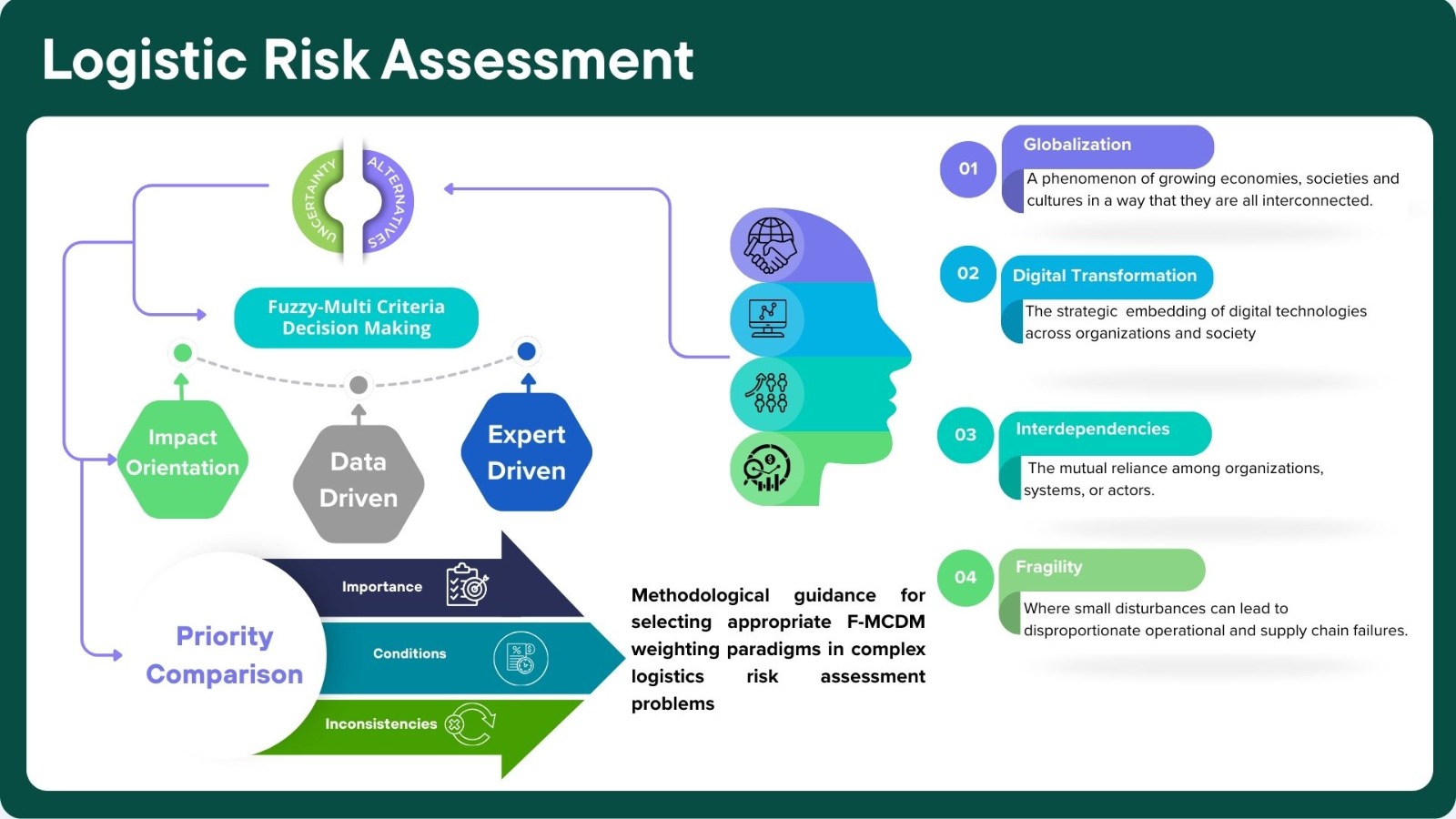
Logistics and supply chain systems operate under increasingly complex risk environments shaped by globalization, digital transformation, and multi-layered operational interdependencies. In such contexts, fuzzy multi-criteria decision-making (FMCDM) approaches are widely employed to support risk evaluation problems characterized by qualitative judgments and epistemic uncertainty. Despite their extensive use, limited attention has been paid to how different fuzzy weighting paradigms implicitly construct and interpret criterion importance within the same decision framework. This study addresses this issue by comparatively examining expert-driven, data-driven, and impact-oriented fuzzy weighting approaches within a unified logistics risk assessment context. Fermatean fuzzy SWARA, fuzzy CRITIC, and fuzzy MEREC are employed to represent cognition-driven, structure-driven, and consequence-oriented constructions of importance, respectively. All methods are applied to the same expert-based decision structure to ensure analytical consistency and comparability. The results reveal that substantially different risk prioritization patterns emerge across weighting approaches, even when expert judgments and decision conditions are held constant. These differences reflect methodological variations in how importance is operationalized rather than inconsistencies in data or expert input. By highlighting the method-dependent nature of importance construction, the study contributes to a clearer understanding of fuzzy weighting behavior and provides methodological guidance for selecting appropriate FMCDM weighting paradigms in complex logistics risk assessment problems.
Downloads
Published
How to Cite
Issue
Section
License
Copyright (c) 2025 Mine Konur Bilgen, Kaan Bilgen (Author)

This work is licensed under a Creative Commons Attribution 4.0 International License.
ABSJ is published Open Access under a Creative Commons CC-BY 4.0 license. Authors retain full copyright, with the first publication right granted to the journal.