Application challenges of modern education technology in China's higher education teaching management: A fuzzy MARCOS method
DOI:
https://doi.org/10.59543/9gaa3t67Keywords:
Multi-criteria decision-making; q-rung picture fuzzy set; barriers; MARCOSAbstract
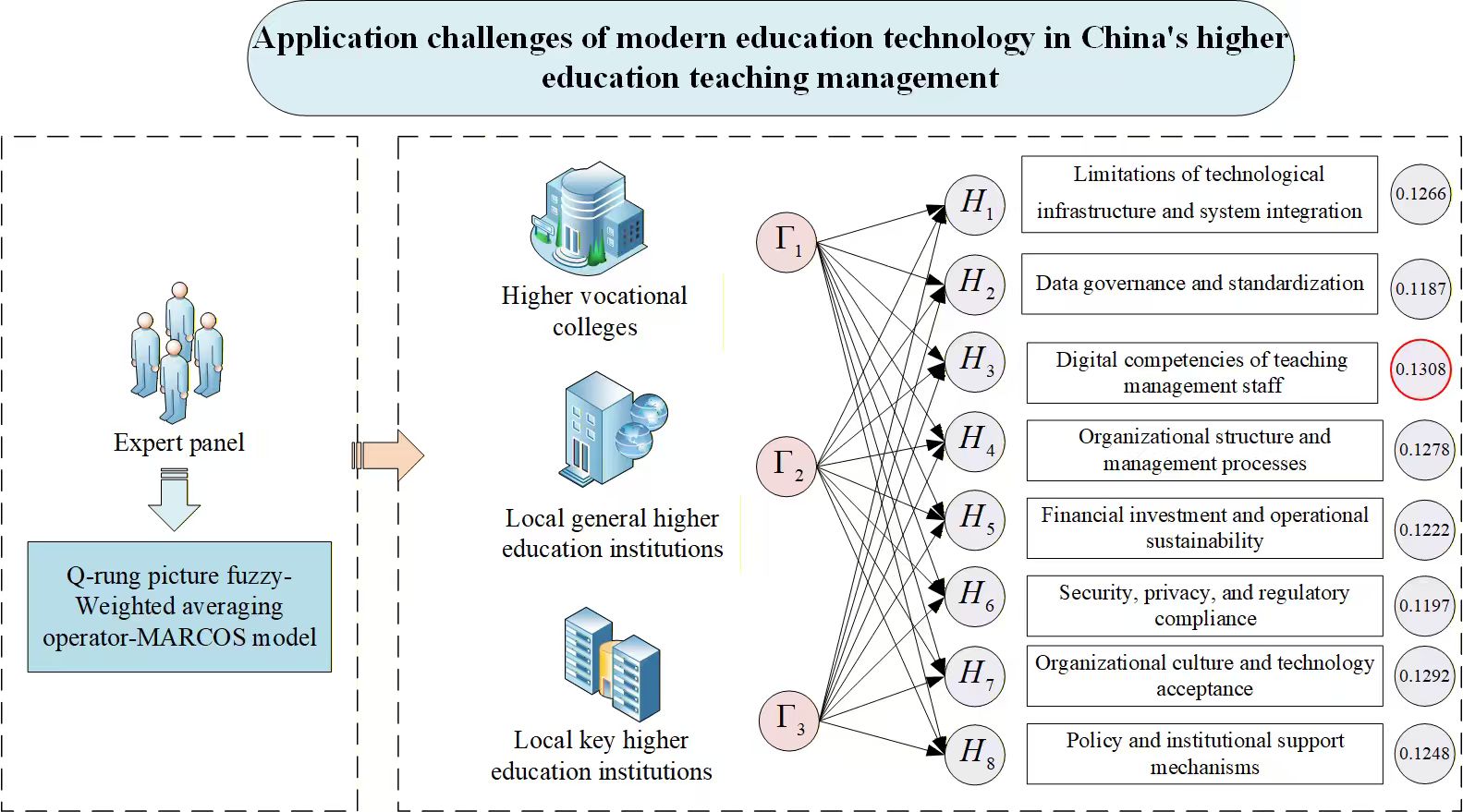
To systematically evaluate the barriers to the adoption of modern educational technology in the teaching management of higher education institutions in China, this study introduces an integrated evaluation framework based on MCDM to discuss existing problems. First, a comprehensive barrier evaluation indicator system is constructed by synthesizing existing studies on educational technology implementation and the practical objectives of teaching management in Chinese higher education. Second, a q-rung picture fuzzy set (q-RPFS) is employed to characterize experts’ assessments, enabling a more flexible and accurate representation of uncertainty, hesitation, and conflicting judgments inherent in barrier evaluation. The weighted averaging (WA) operator is then applied to aggregate fuzzy evaluation information across indicators. Third, the Measurement of Alternatives and Ranking according to Compromise Solution (MARCOS) method is adopted to rank the identified barriers by considering both ideal and anti-ideal solutions, thereby enhancing the robustness and discriminative power of the evaluation results. Finally, a case study involving representative higher education institutions in China is conducted to validate the feasibility and effectiveness of the proposed framework. This article considers different types of universities as alternatives, and digital competencies of teaching management staff has the greatest impact on them. The results demonstrate that the integrated approach provides a systematic and reliable tool for identifying and prioritizing key barriers to modern educational technology in higher education teaching management, offering valuable insights for policy formulation and managerial decision-making.
Downloads
Published
How to Cite
Issue
Section
License
Copyright (c) 2026 Huawei Wang (Author)

This work is licensed under a Creative Commons Attribution 4.0 International License.
ABSJ is published Open Access under a Creative Commons CC-BY 4.0 license. Authors retain full copyright, with the first publication right granted to the journal.