A Shapley Value-Based Argumentation Framework Integrating CRITIC and MARCOS for Sustainable Supplier Evaluation: Evidence from a Global Semiconductor Supply Chain
DOI:
https://doi.org/10.59543/cg894606Keywords:
Shapley value, cooperative game theory, interaction index, MARCOS, argumentation, technology supply chain, ESG, supplier evaluationAbstract
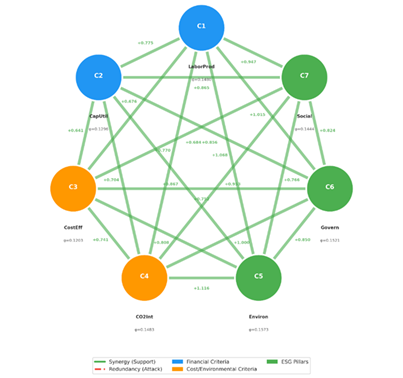
Supplier evaluation in technology supply chains requires transparent, defensible multi-criteria decision-making (MCDM) methods that capture complex interactions among financial, environmental, and governance criteria. This study proposes a novel framework integrating Shapley values from cooperative game theory with the MARCOS method, augmented by an argumentation-based interpretation layer grounded in Shapley interaction indices. Unlike classical CRITIC weighting, the Shapley value considers the marginal contribution of each criterion across all 128 possible coalitions, producing weights that reflect each criterion’s true cooperative importance. The Shapley interaction index quantifies synergy or redundancy between every pair of criteria, providing a natural mapping onto argumentation support and attack relations. Applied to 52 first-tier suppliers in a leading semiconductor corporation’s global supply chain across seven evaluation criteria, the framework reveals that Shapley weights are substantially more balanced than classical CRITIC weights. The interaction analysis uncovers that cross-domain criterion pairs exhibit stronger synergies than within-domain pairs. Microsoft, Intel, BMW, SAP, and HP emerge as the top five suppliers, and sensitivity analysis confirms exceptional stability in rankings (mean Spearman ρ = 0.9950). An argumentation-based quadrant classification reveals that 84.6% of suppliers cluster along the performance–ESG diagonal.
Downloads
Published
How to Cite
Data Availability Statement
The data used in this study were sourced from the Refinitiv Eikon database.
Issue
Section
License
Copyright (c) 2026 Huai-Wei Lo, Sheng-Wei Lin (Author)

This work is licensed under a Creative Commons Attribution 4.0 International License.
ABSJ is published Open Access under a Creative Commons CC-BY 4.0 license. Authors retain full copyright, with the first publication right granted to the journal.