Applying the CRADIS Method with Probabilistic Uncertain Linguistic T-Spherical Fuzzy Sets for Circular Supplier Selection
DOI:
https://doi.org/10.59543/0ajp5435Keywords:
PULTSFS; CRADIS; circular supplier selection; combined weighting; multi-criteria decision-makingAbstract
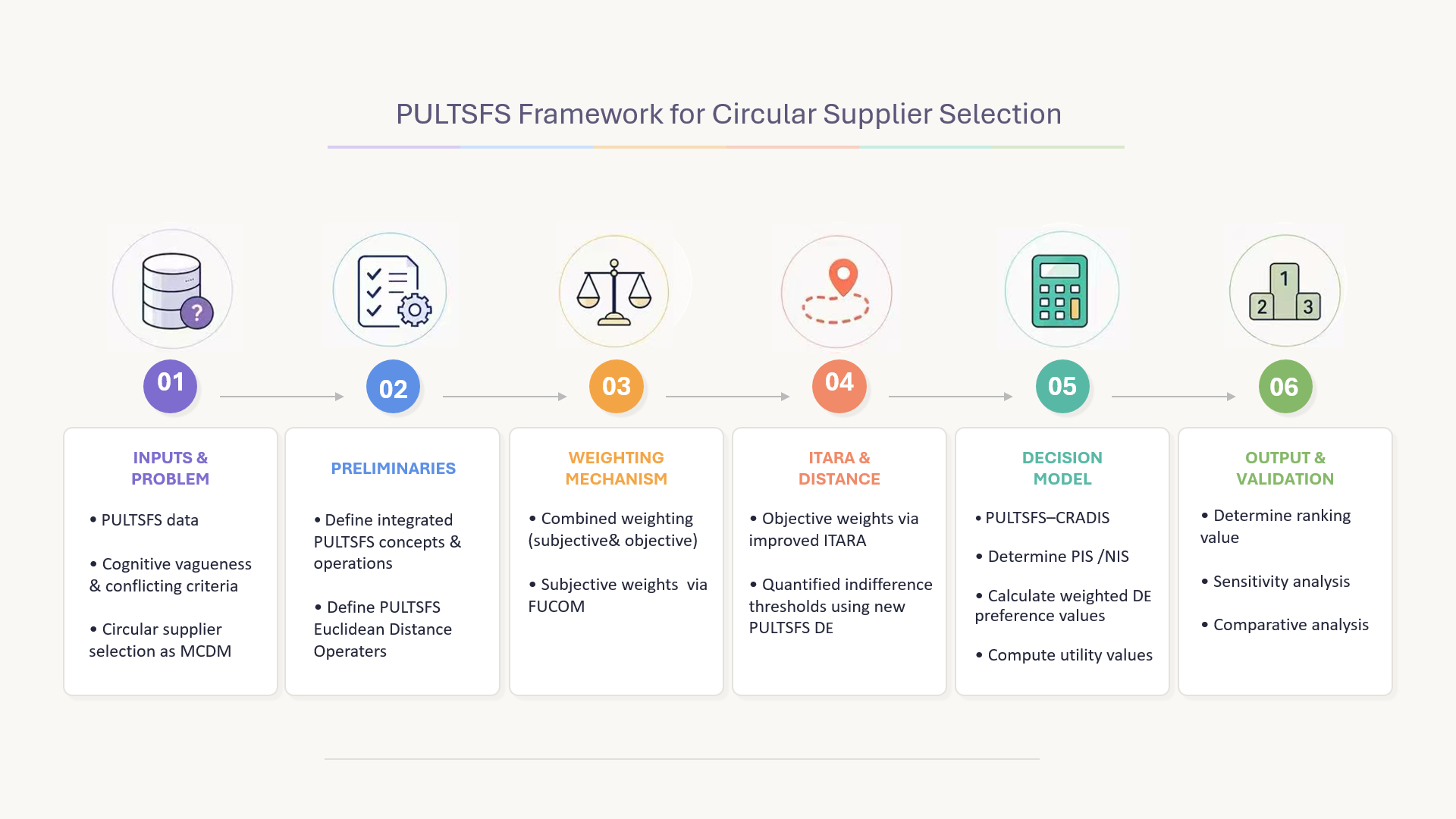
This paper proposes a multi-criteria decision-making model based on the Probabilistic Uncertain Linguistic T‑Spherical Fuzzy Set (PULTSFS), integrating FUCOM, ITARA, and CRADIS, to address the ambiguity and uncertainty inherent in evaluation information for circular supplier selection. It also tackles the limitations of existing CRADIS methods in complex fuzzy environments, the lack of a scientific mechanism that synergizes subjective and objective weighting, and the incomplete depiction of evaluation information. First, a Euclidean distance measure is defined based on the relevant concepts of PULTSFS. Next, the subjective weights of the criteria are derived using the Full Consistency Method (FUCOM), while the objective weights are determined by extending the ITARA method within the PULTSFS framework, thereby establishing a combined weighting mechanism that integrates subjective and objective considerations. Finally, a multi-criteria decision-making model is constructed based on the novel PULTSF-CRADIS approach. Using circular supplier selection as a case study, sensitivity analysis and comparative validation demonstrate that the proposed model yields robust and reliable ranking results, with significantly enhanced capability in handling uncertain information and improved adaptability to complex decision-making scenarios, offering a more precise decision-making tool for supplier selection in the context of the circular economy.
Downloads
Published
How to Cite
Data Availability Statement
Not applicable.
Issue
Section
License
Copyright (c) 2026 Kuo Zhang, Ning Zhong, Haolun Wang (Author)

This work is licensed under a Creative Commons Attribution 4.0 International License.
ABSJ is published Open Access under a Creative Commons CC-BY 4.0 license. Authors retain full copyright, with the first publication right granted to the journal.