A Generative AI–Based Decision-Support Framework for Early-Stage Architectural Design: Evidence from Sustainable Tiny Houses
DOI:
https://doi.org/10.59543/nnc2a471Keywords:
Generative Artificial Intelligence, Design Decision Support, Text-to-Image Models, Architectural Design Reasoning, Sustainable Tiny HouseAbstract
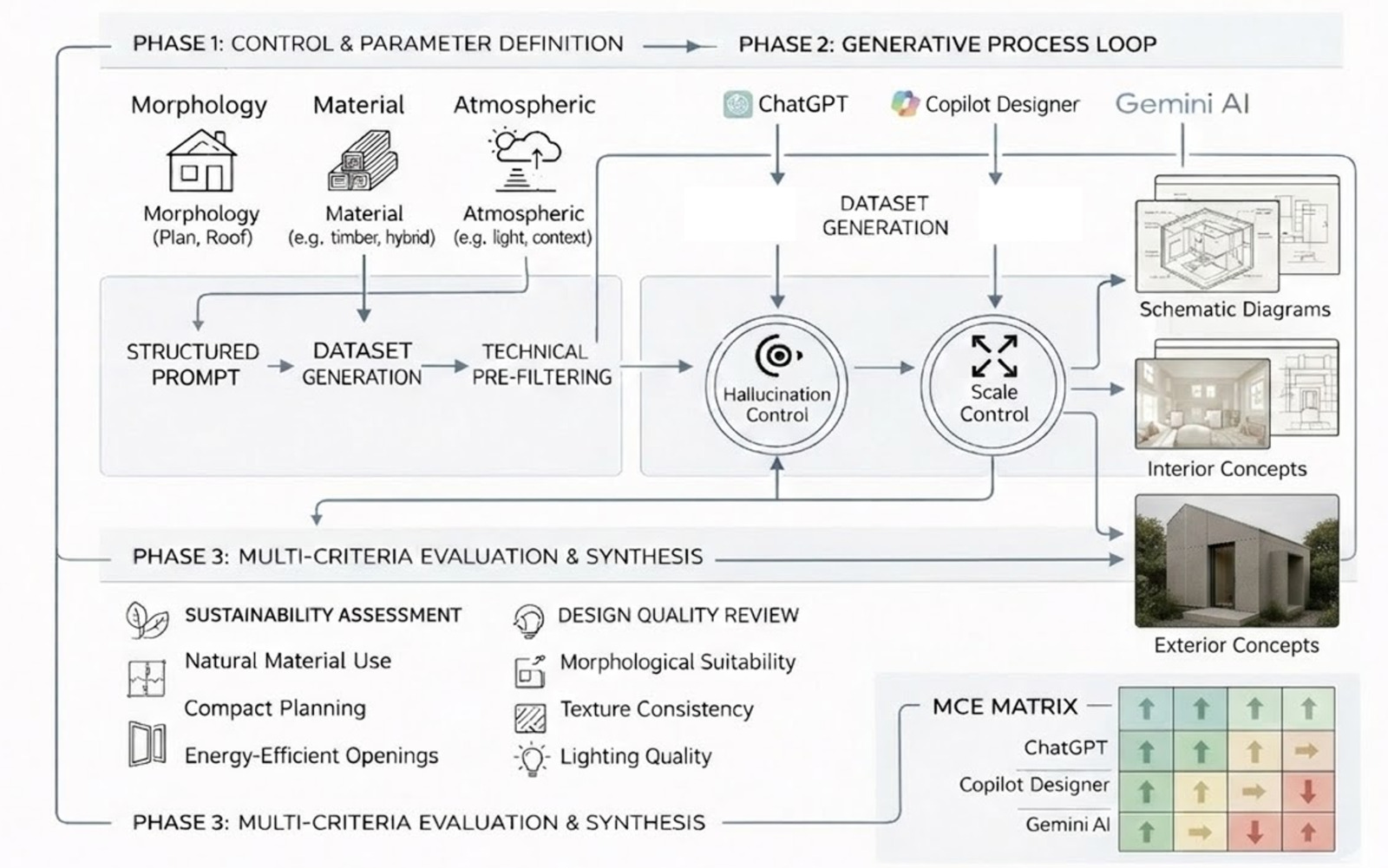
This study investigates the potential of generative artificial intelligence–based text-to-image models as early-stage decision-support tools in sustainable tiny house design. Within the conceptual design process, the study systematically models key components—formal schema development, material selection, and spatial atmosphere—through a controlled prompt framework that enables structured comparison of design alternatives. Design outputs generated by diffusion-based models, including ChatGPT (DALL·E 3), Copilot, and Gemini AI, are evaluated using a multi-criteria framework encompassing sustainability principles (use of natural materials, compact planning, energy-efficient openings), typological consistency, and overall design quality. To examine how prompt variations shape design outcomes, three analytical dimensions are defined: (1) morphological decisions (plan layout, roof typology, form), (2) material decisions (timber, recycled composites, hybrid systems), and (3) spatial atmosphere (daylighting, color palette, interior warmth). The findings show that text-to-image workflows not only accelerate the generation of design alternatives but also enable a structured interpretation of how different design options align with specified criteria. In this sense, generated outputs function as interpretable design propositions that can be comparatively assessed within a transparent evaluation logic. The results further suggest that generative AI supports designers by externalizing design reasoning, facilitating the exploration, comparison, and justification of early-stage decisions. These results position generative AI as a viable component of next-generation design decision-support systems, particularly in contexts where rapid iteration, multi-criteria evaluation, and the articulation of design reasoning are critical.
Downloads
Published
How to Cite
Issue
Section
License
Copyright (c) 2026 Tuğçe Çelik (Author)

This work is licensed under a Creative Commons Attribution 4.0 International License.
ABSJ is published Open Access under a Creative Commons CC-BY 4.0 license. Authors retain full copyright, with the first publication right granted to the journal.