A Hybrid Deep Learning-Driven Stochastic MCDM Framework for Uncertainty-Aware Renewable Energy Resource Selection
DOI:
https://doi.org/10.59543/9hjx0v16Keywords:
Deep Learning, Stochastic MCDM, Renewable Energy Policy, Predictive Trust, Monte Carlo SimulationAbstract
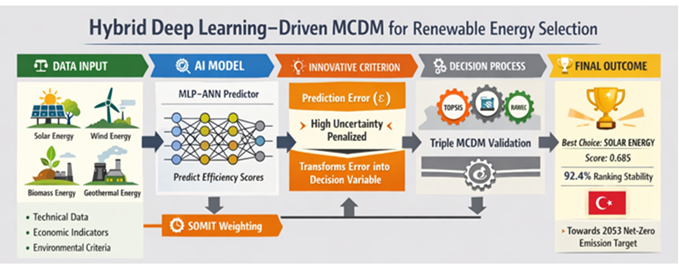
Renewable energy source selection is a difficult decision for policymakers due to the high level of uncertainty associated with it, along with the technical factors that accompany it. Most Multi-Criteria Decision Making (MCDM) techniques are based on fixed input parameters or the opinions of experts, which do not account for the predictive uncertainties inherent in energy production data. This research aims to provide a more effective, efficient, and robust framework for the selection of the best mix of renewable energy sources for the future. A five-phase methodology is proposed for this purpose, where the first phase involves the application of the Subjective-Objective Median-based Importance Technique (SOMIT) for the calculation of the weights of the decision criteria. In the second phase, a Multi-Layer Perceptron (MLP) neural network is designed for the prediction of the technical efficiency of solar, wind, biomass, and geothermal energy. Third, the absolute error residuals are monitored for the development of the ANN Uncertainty Criterion. In the fourth phase, the triple validation of the uncertainty-aware data is performed through the application of the MCDM engine, which is based on the TOPSIS, PROMETHEE II, and RAWEC algorithms. In the fifth phase, sensitivity analysis is performed, followed by the Monte Carlo Simulation for testing the robustness of the framework. The results from applying the proposed framework show a clear change in preference. For Türkiye’s 2053 net zero target, solar energy is now considered the best future energy source, with a preference score of 0.685. This is higher than wind energy, which most decision-makers previously favored because of its capacity factor. Thus, the proposed framework is more effective, efficient, and robust, as indicated by the Monte Carlo Simulation results, where the results obtained from the application of the proposed framework were stable for 92.4% of the scenarios.
Downloads
Published
How to Cite
Data Availability Statement
All data generated or analyzed during this study are included in this published article.
Issue
Section
License
Copyright (c) 2026 Gülay Demir (Author)

This work is licensed under a Creative Commons Attribution 4.0 International License.
ABSJ is published Open Access under a Creative Commons CC-BY 4.0 license. Authors retain full copyright, with the first publication right granted to the journal.