Probabilistic Uncertain Linguistic T-Spherical Fuzzy Aggregation Operators-based Multi-Criteria Decision-Making Method and Its Application with Unknown Weight Information
DOI:
https://doi.org/10.59543/289xyy59Keywords:
Probabilistic uncertain linguistic T-spherical fuzzy set;, Aggregation operators;, Multi-criteria decision-makingAbstract
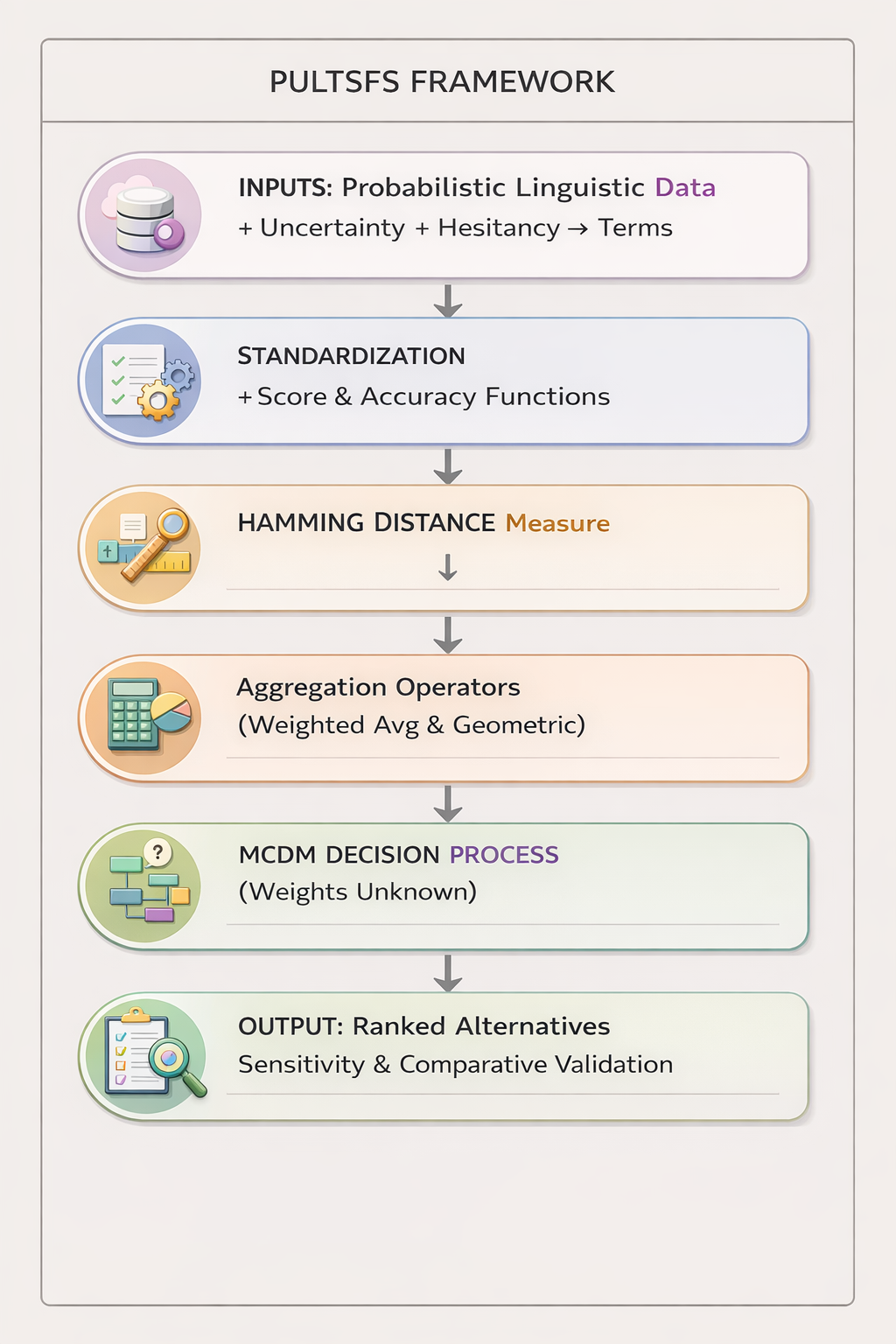
To comprehensively and precisely capture the fuzziness, uncertainty, hesitancy, and inherent randomness of evaluation information, this paper introduces a novel generalized concept: the probabilistic uncertain linguistic T-spherical fuzzy set (PULTSFS). This concept is developed by leveraging the unique advantages of both probabilistic uncertain linguistic term set (PULTS) and T-spherical fuzzy set (TSFS). The study begins by proposing a standardization method for PULTSFS, defining its score and accuracy functions, and establishing a Hamming distance measure for any two probabilistic uncertain linguistic T-spherical fuzzy numbers (PULTSFNs). Building upon the fundamental operational rules of PULTSFNs, the research then develops and analyzes the properties of weighted average and weighted geometric aggregation operators (AOs) tailored for PULTSFS. A decision-making framework using these AOs is subsequently constructed to address multi-criteria decision-making (MCDM) challenges where criteria weights are entirely unknown. Finally, the practicality and efficacy of the proposed method are validated through a numerical example, which includes a sensitivity analysis and comparative benchmarks against existing methods. The results demonstrate that the proposed method significantly improves the accuracy and reliability of resolving complex decision-making scenarios, ensuring that the resulting decisions are more practical and better aligned with real-world requirements.
Downloads
Published
How to Cite
Issue
Section
License
Copyright (c) 2026 JingYing HUANG, HaoLun WANG, Kuo ZHANG (Author)

This work is licensed under a Creative Commons Attribution 4.0 International License.
ABSJ is published Open Access under a Creative Commons CC-BY 4.0 license. Authors retain full copyright, with the first publication right granted to the journal.