Bayesian Hierarchical Modeling and Clustering for Malignant Cancer Diagnosis
DOI:
https://doi.org/10.59543/w22sya71Keywords:
Late-stage cancer; Bayesian hierarchical logistic regression; No-U-Turn sampler; Patient heterogeneity; Cancer risk clusterAbstract
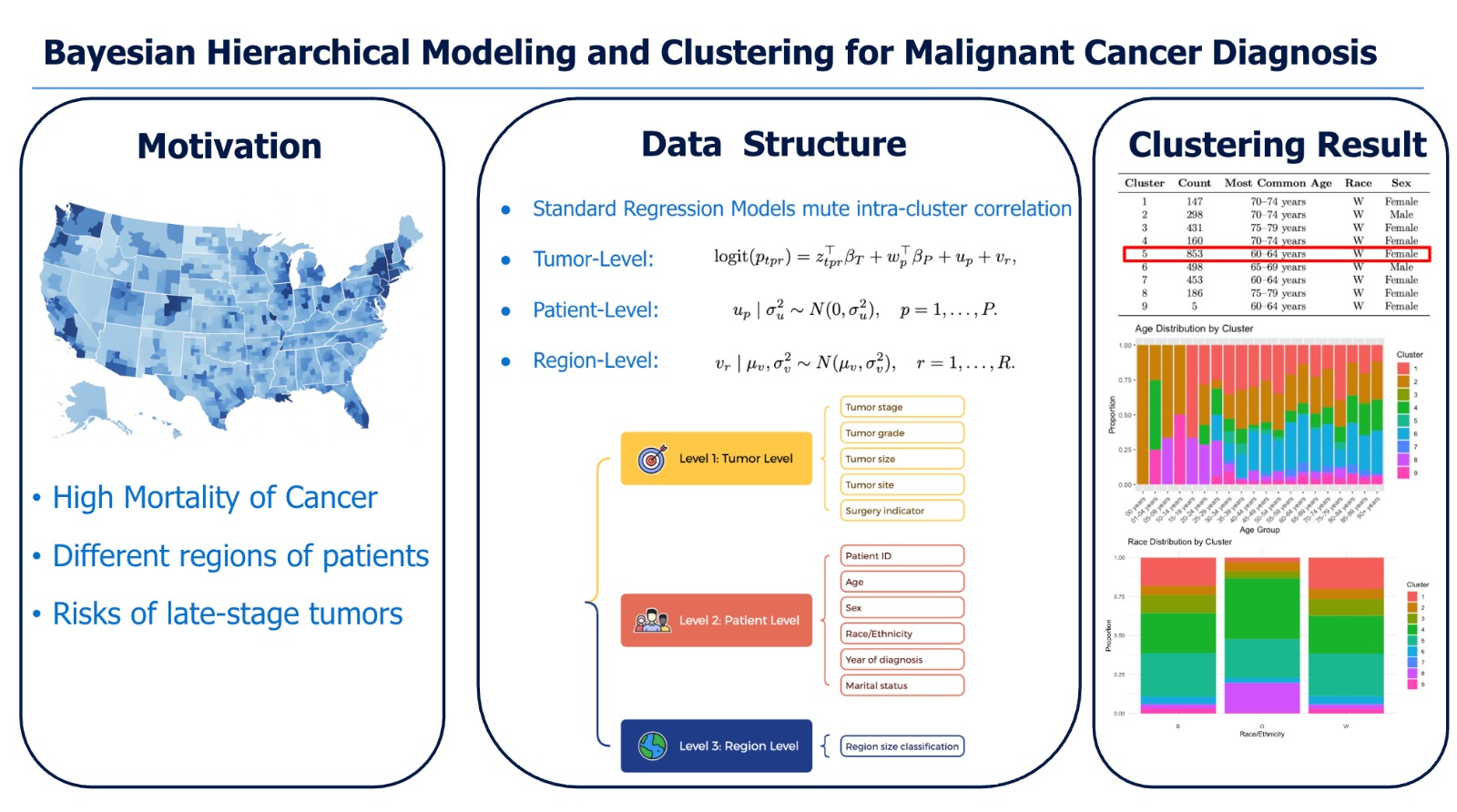
Late-stage cancer diagnosis remains a major barrier to improving survival rates, yet the relative contributions of tumor, patient, and region-level factors have not been well quantified. In this study, we develop a 3-layer Bayesian hierarchical logistic regression model to investigate late-stage cancer diagnosis. The model includes fixed effects for tumor characteristics and random effects for patients and regions. Model parameters are estimated using the No-U-Turn Sampler, and posterior samples are evaluated with effective sample sizes and convergence diagnostics. From intra-class correlation estimates, we find that patient-level variation has a substantially stronger influence on late-stage diagnosis than region-level variation. Lastly, we utilize a Gaussian Mixture Model to cluster posterior patient-level random effects, identifying nine distinct clusters characterized by age, sex, and tumor features. Our findings suggest that individualized, patient-focused strategies may be more effective than geographically targeted approaches for promoting earlier cancer detection.
Downloads
Published
How to Cite
Issue
Section
License
Copyright (c) 2026 Sijia Zhu, Jonathan Ma, Zhe Liu (Author)

This work is licensed under a Creative Commons Attribution 4.0 International License.
ABSJ is published Open Access under a Creative Commons CC-BY 4.0 license. Authors retain full copyright, with the first publication right granted to the journal.